SCAO Subsystem
The Single Conjugate Adaptive Optics (SCAO) subsystem of ANDES provides diffraction-limited performance for the Integral Field Unit (IFU) observing mode. By correcting atmospheric turbulence and delivering a high-quality point spread function to the IFU, SCAO enables high-contrast, high-resolution spectroscopy with the ELT, supporting the characterization of rocky exoplanets in the habitable zones of nearby stars.
The SCAO system is designed for observations at very small angular separations from the host star. This is essential for targets such as Proxima Centauri b, where the planet-to-star contrast can approach 10⁻⁷ at separations of only a few tens of milliarcseconds. Under median seeing conditions, SCAO is designed to deliver a raw stellar contrast of approximately 1.5 × 10⁻³ at 20 mas in the Y and J bands. Combined with the high spectral resolution of ANDES, this performance will enable the detection and characterization of faint planetary signals in reflected light.
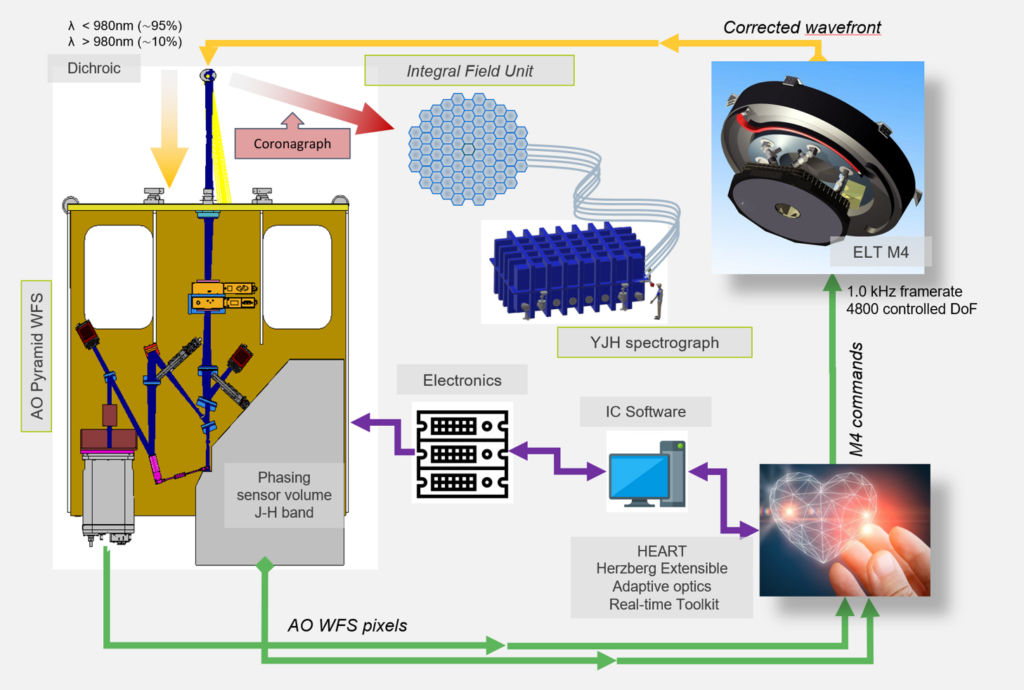
SCAO operates in close connection with the ANDES Front-End and IFU. Visible light is used for wavefront sensing, while near-infrared science light is transmitted towards the IFU and YJH spectrograph. The adaptive optics correction is provided by the ELT adaptive mirror M4 and driven by a modulated Pyramid Wavefront Sensor operating from 600 to 980 nm. An infrared phasing channel provides differential piston measurements, while a HEART-based real-time controller processes the wavefront sensor information and commands the adaptive mirror.
To further improve the contrast delivered to the IFU, SCAO includes a deployable Classical Lyot Coronagraph operating from 950 to 1800 nm, with a possible extension towards 2.4 μm. A dedicated camera arm equipped with a Zernike wavefront sensor measures non-common-path aberrations and provides additional corrections to the adaptive optics loop.
The combined SCAO and coronagraphic system provides the spatial quality and contrast required for high-resolution spectroscopy of nearby exoplanets in the YJH wavelength range, opening a unique observational window on potentially habitable worlds.